


The story of AI is starting to look less like hype and more like real infrastructure.
For a while, the public story of AI was driven by spectacle.
A new model would launch, benchmarks would rise, and demos would go viral. For a while, the industry acted as if raw capability alone determined the future.
That phase is fading, and a new focus is emerging.
What matters more now is not whether AI can impress people in a controlled setting. The real test is whether it can perform in the messier conditions of the real world, such as in governments, enterprise systems, fraud operations, security workflows, and the technical infrastructure needed for large-scale deployment.
This is where the more lasting story of AI is taking shape, showing a shift away from spectacle.
The most durable uses of AI are not always the most attention-grabbing. They are the ones that fit into regular work, create measurable value, and can handle compliance, procurement, data governance, and human monitoring. In short, the focus is shifting from novelty to building reliable systems.
This shift toward long-term impact was visible across the latest wave of developments.
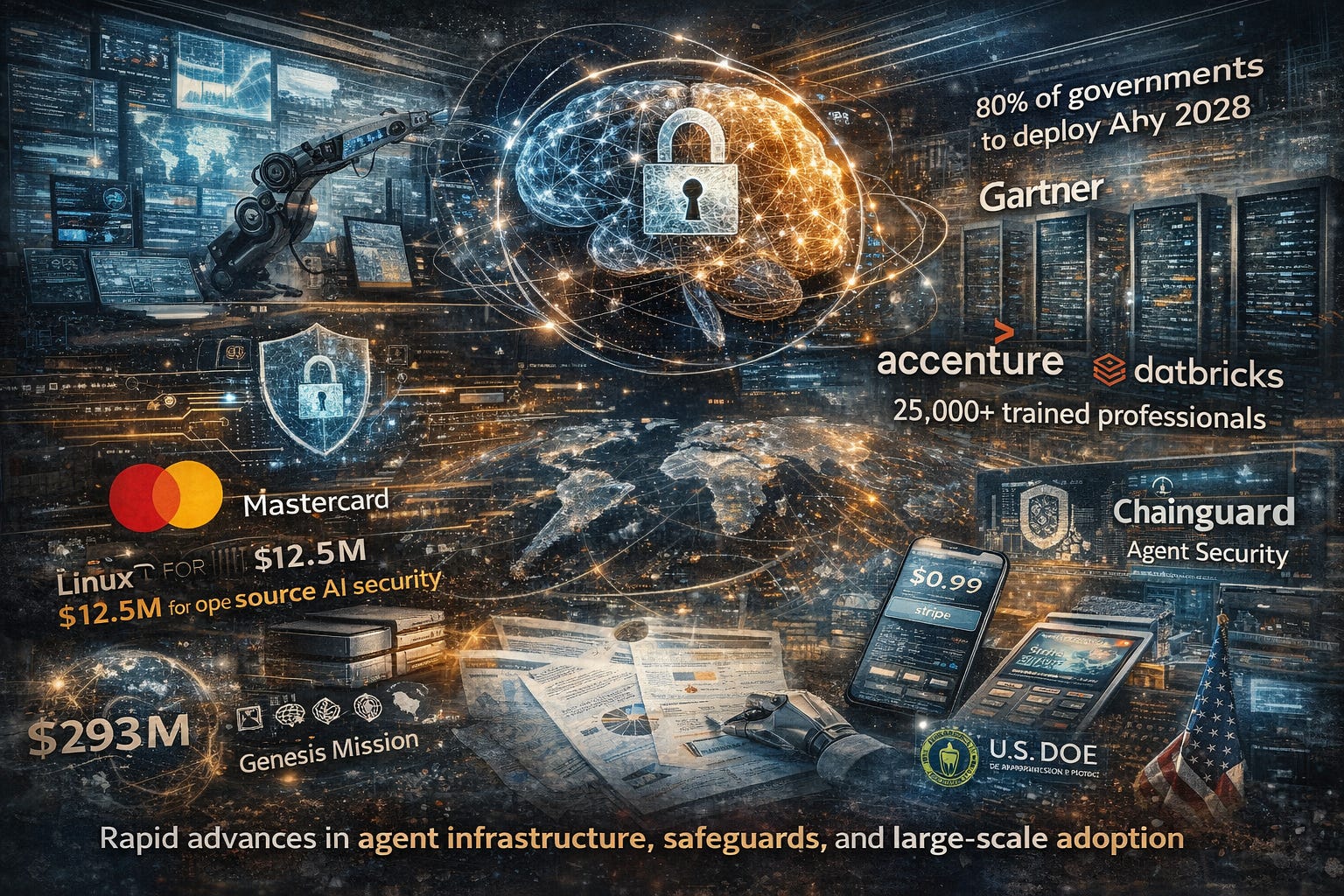
Gartner forecasts 80% of governments will deploy AI agents by 2028, and 70% will require explainability and human oversight by 2029. Public institutions want decisions that are “faster, consistent, and explainable.” This is a forecast about operational adoption, not experimentation.
Finance and security follow the same trend. Mastercard’s tabular model, trained on anonymized transaction data, can learn key data features on its own. Fraud, loyalty, and cybersecurity are not side projects; they are ongoing business challenges. When AI helps with these, it becomes part of the core system, not simply a novelty.
The enterprise approach is maturing in the same way. Accenture and Databricks have expanded their AI partnership, supported by 25,000 professionals. The focus is on deploying AI at scale, not just innovating merely for its own sake. This is about putting AI into practice, not just experimenting.
Under these systems is situated something even more important: infrastructure. Recent research found that object storage supports 91% of private AI deployments. This corrects a common misconception. Durable AI needs more than just the model; it also requires storage, retrieval, governance, and throughput to work in actual conditions.
Security is now closely linked to AI deployment. The Linux Foundation announced $12.5 million to improve open-source security. Chainguard introduced stronger agent skills for safer reuse. NVIDIA’s NemoClaw and OpenShell focus on policy-based security and privacy. Together, these steps show a clear trend: the industry is preparing for AI that takes action. When AI starts to act, security becomes a core part of the product, not simply a minor detail.
Even the more experimental side of the market is becoming more structured. Google DeepMind’s proposed framework for AGI measurement, along with its Kaggle-based evaluation efforts, shows that capability claims now need clear benchmarks. Stripe and Tempo’s Machine Payments Protocol shows a similar change. Stripe called it “an open standard, internet-native way for agents to pay.” This is a small but important sign of where the ecosystem is going. As agents are expected to transact, coordinate, and work across several workflows, they will need systems for permissions and controls.
All of these developments point to a larger, underlying trend.
AI is no longer simply about impressive tools. It is becoming a core part of how work gets done, built on usefulness, governance, infrastructure, and trust. The applications that last are tied to repetitive, high-value, and measurable tasks. Fast-moving organizations build systems, not just models. Now, the market values reliability as much as capability.
As a result, the most important question in AI right now is evolving.
It is no longer simply: what can the model do?
Instead, the question is whether the system can make the capability safe enough to use, measurable enough to trust, and valuable enough to keep.
That is the threshold separating hype from durability.
Increasingly, the real AI race is won on this ground.
Subscribe for a clear, signal-over-noise take on the biggest developments in AI, technology, and the shifting power dynamics behind them.
Named with a slight nod to an old fictional safeguard, this newsletter looks at AI in the world most people actually live in. Not as spectacle, not as prophecy, but as a growing presence in ordinary systems, decisions, and routines. Its effects will sometimes be obvious and sometimes almost invisible, folded into services that seem faster, easier, or simply unavoidable. The aim is to understand those changes without hype: how they alter daily life, who they serve, who they burden, and what sort of civic and social world they are helping to create. - “In peace and with goodwill,” Klaatu.