


Michael Coren’s Washington Post column opens with a provocation: buy a gasoline car tomorrow, junk it, buy an electric, and drive it for a decade. The climate wins. Behind the rhetoric is a real, peer-reviewed paper in Science — replace a working gas car with an EV now and you cut lifetime emissions by more than half, repaying the new car’s manufacturing emissions in about three years. In 92% of the scenarios the researchers modeled, the planet is better off.
Read that as the average consumer, and it’s hard to know what to do with it. The advice keeps changing. Repair your phone — most of its damage was done the day it was built. Junk your car — most of its damage is done every day you drive it. Keep the old dishwasher — or don’t, depending on how often you run it. Buy the efficient bulb, obviously, but five years ago the responsible choice was a different bulb. The discussion evolves faster than a household budget can, and every new study moves the line between the green choice and the greenwash. The reader is left doing arithmetic the study itself never asked them to do: with what money, on what grid, driving how far?
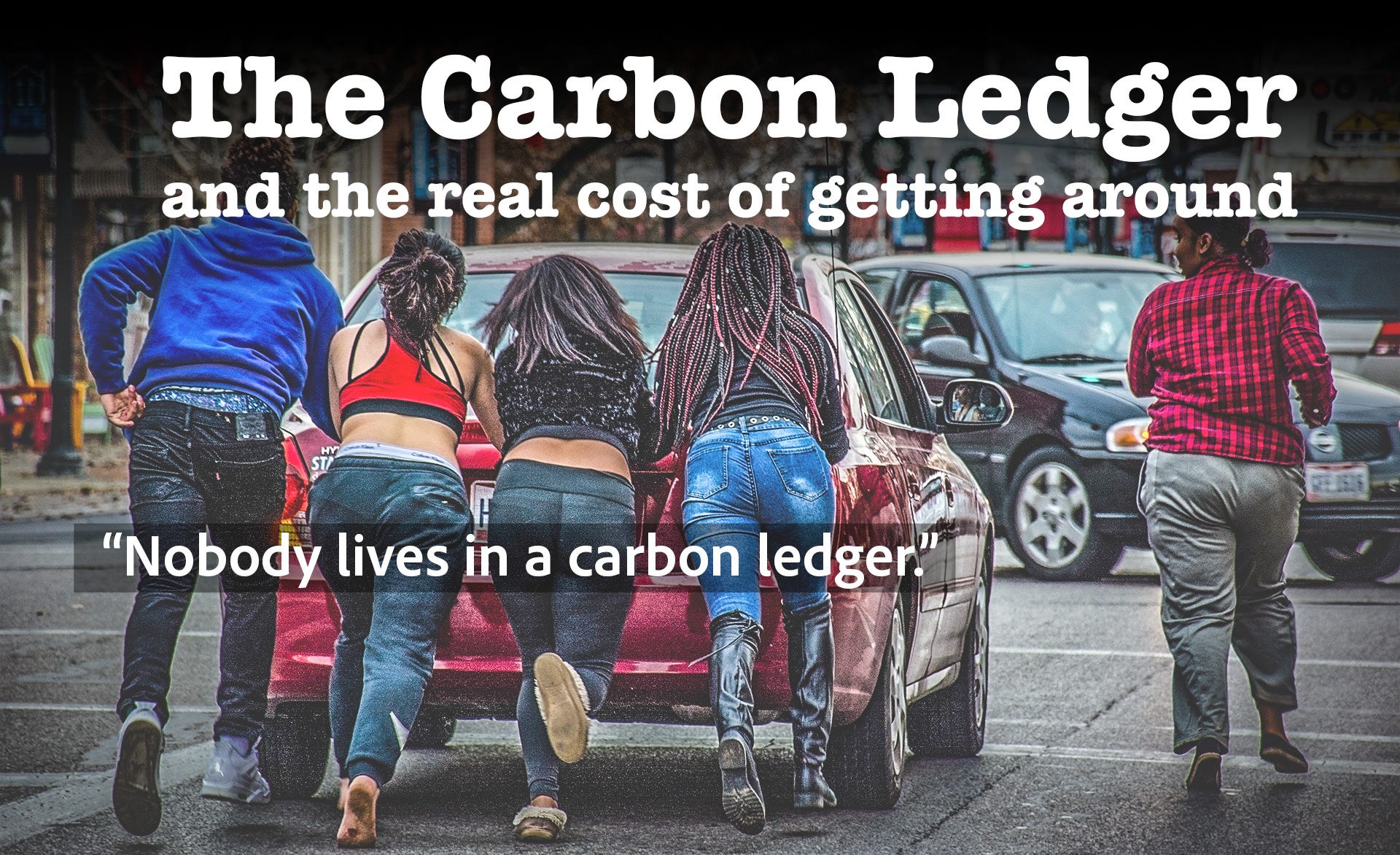
That’s the math. But nobody lives in a carbon ledger. Transportation’s real cost runs through your wallet, the used-car lot, and the way American life is built around the automobile — and none of that shows up in the study’s arithmetic. Carbon savings alone do not decide what a driver should do; they are only one part of the decision.
Start with the wallet, because that’s where the average consumer starts. The Science paper counts carbon, not dollars. Coren’s own numbers say trading a brand-new gas car for a new EV takes at least five years to pay off financially, even saving $1,500 to $2,500 a year on fuel and maintenance — and that’s before you price the new machine itself. The study’s authors call early retirement of a newer gas car “economically prohibitive under today’s rebates.” For the household running a ten-year-old sedan to work and back, the climate arithmetic is irrelevant until the money arithmetic works. Consumers don’t optimize carbon; they optimize the monthly payment.
Then consider who the advice even applies to. The researchers found a mileage floor below which the EV never repays its manufacturing emissions: about 4,400 miles a year for a car, 6,700 for a pickup. How many drivers know their annual mileage? The low-mileage driver — often older, often careful, often the very person who keeps a car for fifteen years — gets no benefit from the swap. The efficient hybrid driver gets almost none: swapping a plug-in hybrid for a full EV actually raised emissions in the modeled case. So the column’s rhetoric says junk it; the fine print says, well, it depends on how far you drive, what you drive, and what your local power plant burns.
Then follow the car after it leaves your driveway. America runs on a used-car ladder: about two-thirds of lower-income buyers buy used, and nearly four in five privately purchased used cars change hands for under $10,000. New cars bought by wealthier households become somebody else’s affordable car six, ten, fifteen years down the road. Crush a working car early, and you remove a rung. The emissions benefit is real, but so is the family that needed that rung to get to work. Researchers modeling scrappage incentives found that targeting a vehicle’s future emissions, rather than its age, could roughly halve the public cost per ton of carbon avoided — because a flat bounty pays as much to crush a lightly driven efficient car as a heavily driven gas guzzler.
Then there is the environment beyond carbon, the part that keeps shifting under the consumer’s feet. The paper’s ledger is lifetime CO2: what went into building the machine versus what comes out of using it. But manufacturing consumes more than 30 million tons of raw resources a year in Europe alone for replacement products. Discarded appliances generate an estimated 261 million tons of greenhouse gas emissions annually. And the study leaves out battery recycling entirely — not because it doesn’t matter, but because too few electric cars have reached retirement age to support the industry. The counterweight comes from the study’s own lead author: an EV carries a half-ton battery, but a gas car burns twenty tons of petroleum in its life. Burned fuel is gone forever; a battery can be taken apart and used again. The carbon ledger captures none of that, and consumers have no way to price it.
Then there is lifestyle, the part nobody modeled. The researchers assumed the scrapped car vanishes and the EV takes its place. In real life, the gas car hits the used market, and prices drop. Researchers who reviewed the paper flagged the feedback loop: cheaper used cars can pull people off public transit and into cars. And in this country, the car is not really a consumer choice — more than nine in ten urban trips in the U.S. and Canadian sample were made by car, compared with fewer than half in Europe. For many households, the car is how you get to work, get the kids to school, and see a doctor. Telling those households the greenest move is to junk a working car misunderstands what the car is.
So the repair-or-replace question Coren raises is the right one, and the ratio he and the researchers offer—how much energy goes into building a machine versus running it over its life—is genuinely useful. But consumers trying to keep up with a constantly evolving discussion deserve honesty about what the numbers can and can’t tell them. Repair the phone, where most emissions are in manufacturing. Replace the incandescent bulb, obviously. In between, estimate actual use: the seldom-used dishwasher may not warrant replacement; the always-on television might. The full cost of technology — a car, an appliance, anything plugged in or fueled up — is measured in dollars a household can actually spend, in affordable machines that exist or don’t, in resources mined and materials recycled, and in a way of life built around the machine. That is the argument: a study that counts only the carbon gets the physics right and the decision wrong.

Enjoyed this roundup?
Subscribe for a clear, signal-over-noise take on the biggest developments in AI, technology, and the shifting power dynamics behind them.
klaatu barada nikto: the safe phrase to prevent world domination.
