

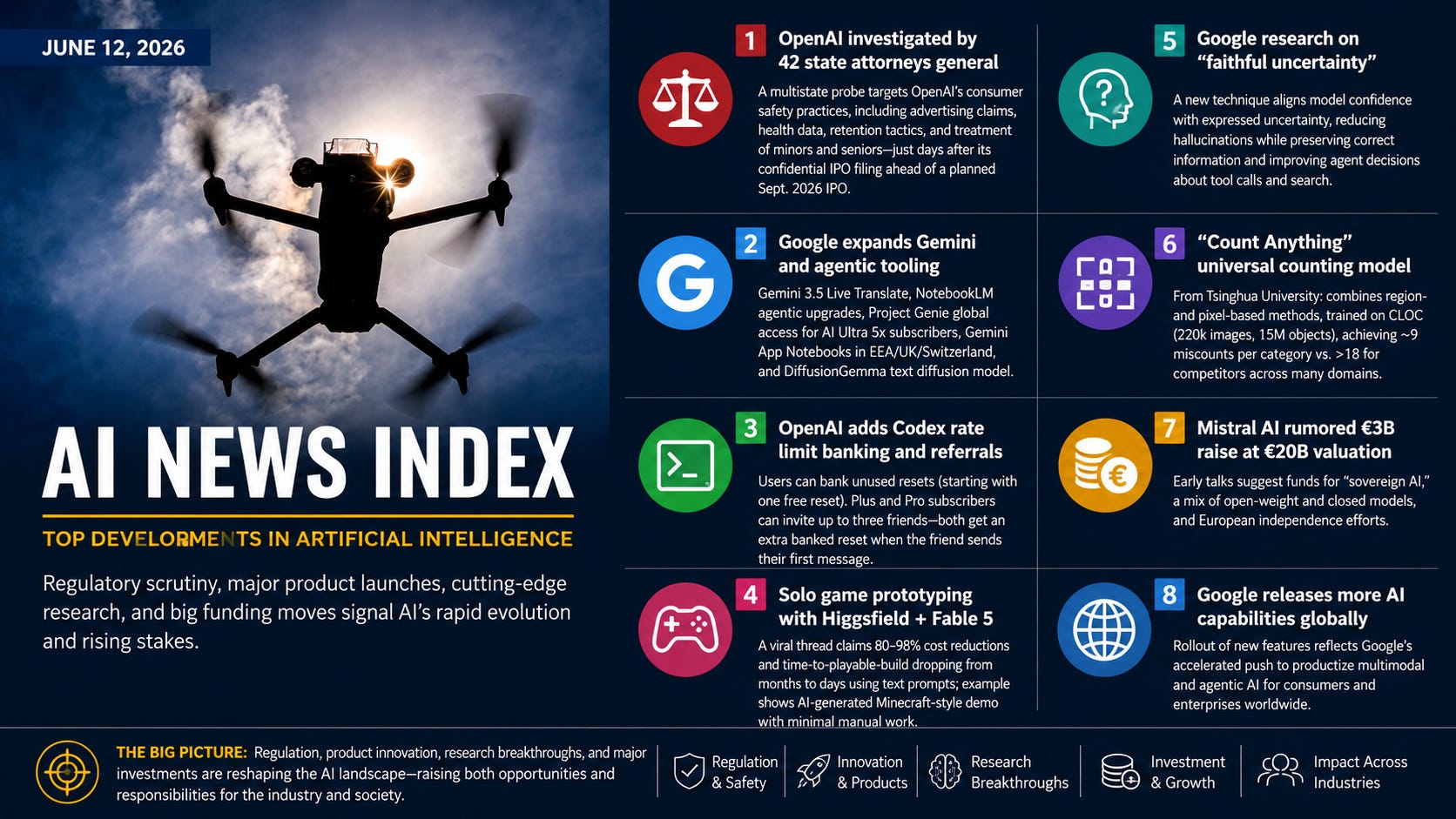
Regulators are examining OpenAI’s safety and data practices ahead of a possible public offering, while Google expands translation, research and agentic tools. Mistral, meanwhile, is reportedly seeking one of Europe’s largest AI funding rounds.
OpenAI is facing a broad investigation by a coalition of U.S. state attorneys general, adding a significant regulatory challenge as the ChatGPT maker prepares for a possible initial public offering.
Reports put the coalition at 42 states. A subpoena issued through New York’s attorney general seeks information about OpenAI’s advertising, user-engagement and retention practices, handling of consumer and health data, treatment of minors and seniors, model behavior and internal safety policies. The inquiry is an information-gathering investigation, not a finding that the company violated the law.
OpenAI said it takes the attorneys general’s concerns seriously and intends to cooperate. The investigation follows other lawsuits and government scrutiny involving claims about ChatGPT’s effects on children and vulnerable users.
The timing raises the financial stakes. OpenAI recently disclosed that it had confidentially filed for a U.S. IPO that could take place as early as September and value the company at as much as $1 trillion, according to Reuters. There is no evidence that the IPO filing itself prompted the investigation, but the probe could complicate disclosures, risk assessments and investor scrutiny ahead of a listing.
Google broadens Gemini’s reach
Google, meanwhile, is moving quickly to turn its AI research into widely available products.
The company recently introduced Gemini 3.5 Live Translate, a speech-to-speech model that automatically detects more than 70 languages and produces translated audio intended to preserve a speaker’s tone, pacing and pitch. Google is rolling it out through the Translate app, offering it to developers through the Gemini Live API and testing it in Google Meet.
Google has also upgraded NotebookLM with more agent-like research capabilities. The new system can help users locate sources, run code in a secure cloud environment and create outputs including spreadsheets, presentations, PDFs and visualizations. Initial access is focused on Google AI Ultra and certain Workspace users.
A June Google AI post also highlighted wider access to Project Genie, Gemini notebooks in the European Economic Area, Britain and Switzerland, and the experimental DiffusionGemma text-generation model. Some of those products were announced before June 11: Google expanded Project Genie to AI Ultra subscribers globally in May, while Live Translate debuted June 9. The post is therefore best understood as a roundup of Google’s recent AI releases rather than a single-day product launch.
OpenAI gives Codex users more control over limits
Alongside the regulatory news, OpenAI added a rate-limit banking feature to its Codex coding service.
Users on Go, Plus, Pro and Business plans receive one banked reset that can be saved and activated when additional usage is needed. For a two-week promotional period, Plus and Pro subscribers can invite as many as three friends. Both users receive another reset after an invited person sends a first Codex message.
The change gives developers more flexibility during periods of concentrated coding work, while the referral component also serves as a customer-acquisition campaign for Codex.
Mistral reportedly considers €3 billion round
French AI developer Mistral is in early discussions to raise about €3 billion at a valuation near €20 billion, according to a report citing unidentified sources.
The potential valuation would be almost twice the €11.7 billion figure attached to Mistral’s previous funding round. The company has positioned itself as a European alternative to U.S. model providers, offering a mixture of open-weight and proprietary models while emphasizing “sovereign AI” infrastructure. Mistral had not confirmed the talks, and the terms could change or fail to produce a deal.
A completed round of that size would underline both the extraordinary capital requirements of frontier AI development and European governments’ and investors’ interest in reducing dependence on American technology providers.
Research targets hallucinations and visual counting
Google researchers are also advancing the idea of “faithful uncertainty,” in which an AI system’s language reflects how confident the model actually is.
Rather than forcing a model to choose between stating an answer confidently or refusing to answer, the approach encourages qualified responses when evidence is incomplete. For AI agents, uncertainty could also inform whether the system should search for more information, call a tool or avoid acting. The work remains a research direction rather than a guarantee that hallucinations can be eliminated.
Separately, researchers from Tsinghua University and other institutions introduced Count Anything, a text-guided vision model intended to count objects across fields ranging from everyday photography to satellite imagery and medical microscopy.
The model combines a region-level system for large, separated objects with a pixel-level counter for small or densely packed targets. It was trained using the CLOC dataset, which contains about 220,000 images and 15 million labeled objects across six visual domains. The authors report that it outperformed competing open-world counting systems on their benchmarks, though the results come from a research preprint and still require broader independent testing.
Viral game-development claims warrant caution
A widely shared social-media thread also claimed that combining Higgsfield tools with an AI model called Fable 5 could reduce game-prototyping costs by 80% to 98% and turn months of development into days.
Those figures appear to be the author’s estimates based on a demonstration, not independently audited results. The example may illustrate how generative tools can accelerate visual prototyping, but it does not establish comparable savings for producing, testing and maintaining a commercially viable game.
The big picture
The developments show the AI sector advancing on three fronts at once.
OpenAI’s investigation demonstrates that consumer protection, health information, youth safety and engagement design are becoming central regulatory questions. Google’s releases show how quickly multimodal and agentic research is being packaged into consumer and workplace products. Mistral’s reported fundraising effort highlights the amount of capital governments and investors may be willing to commit to regional AI independence.
At the same time, research into uncertainty and visual counting shows that models still struggle with basic reliability: knowing when they may be wrong and accurately interpreting complex images. The next stage of AI competition will depend not only on releasing more capable systems, but on proving that they can be trusted, governed and deployed responsibly.

Enjoyed this roundup?
Subscribe for a clear, signal-over-noise take on the biggest developments in AI, technology, and the shifting power dynamics behind them.