


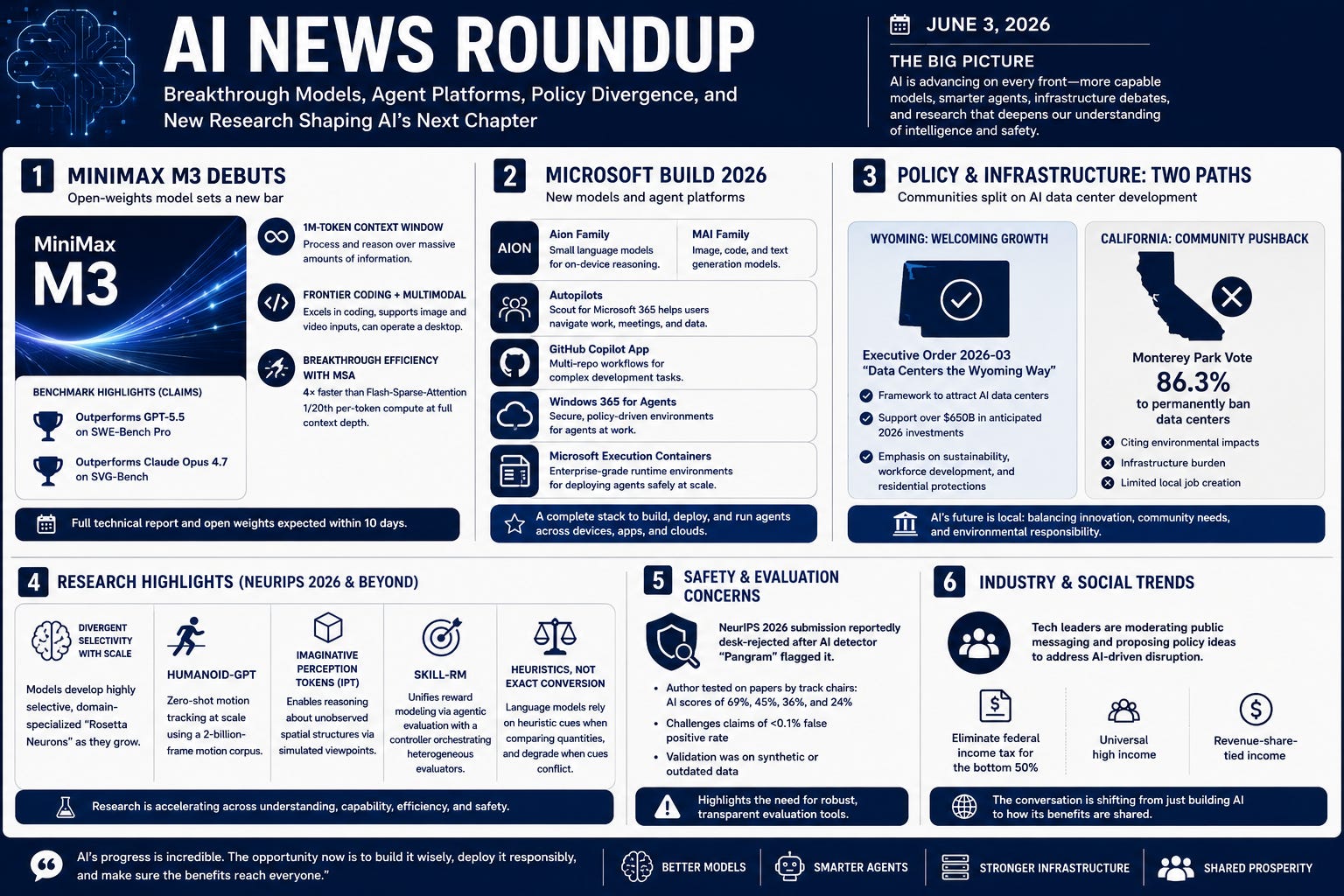
AI is moving into a new phase, and the latest developments show just how quickly the field is expanding.
This week’s news brings together several big themes: more powerful open-weight models, smarter on-device AI, new enterprise agent platforms, growing demand for data centers, fresh research in robotics and reasoning, and a broader public conversation about how society should share the benefits of AI.
The result is a picture of an industry that is not slowing down. It is getting more practical, more ambitious, and more focused on how AI can work in the real world.
MiniMax M3 Pushes Open-Weight AI Forward
One of the biggest announcements comes from MiniMax, which introduced MiniMax M3, a model the company describes as the first open-weight model to combine frontier-level coding ability, a 1 million-token context window, and native multimodality.
That is a lot packed into one model.
A 1 million-token context window means the model can work with very large amounts of information at once. Think long codebases, big research files, detailed business documents, or extended project histories. Instead of losing track after a few pages, models with very large context windows can keep much more of the conversation or task in view.
MiniMax says M3 uses MiniMax Sparse Attention, or MSA, to make that possible more efficiently. Traditional attention methods can become expensive as context grows. MiniMax’s approach is designed to restructure memory access and avoid the usual quadratic scaling problem. The company reports execution that is 4 times faster than Flash-Sparse-Attention and uses just 1/20th of the per-token compute at full context depth.
In everyday terms, this points to AI that can handle bigger jobs with less waste.
The company also says M3 performs strongly on coding and visual benchmarks, including claims that it surpasses GPT-5.5 on SWE-Bench Pro and Claude Opus 4.7 on SVG-Bench. It supports image and video inputs, and MiniMax says it can operate a desktop.
That last part is especially interesting. AI that can understand a screen and operate a computer starts to look less like a chatbot and more like a capable digital assistant.
MiniMax says a full technical report and open weights are expected within ten days. If the release matches its claims, M3 could become an important model for developers, researchers, and teams seeking powerful AI with greater transparency and control.
Microsoft Is Building the Stack for Everyday Agents
Microsoft’s Build 2026 announcements show another side of the AI shift: the rise of agent platforms.
Instead of treating AI as a single assistant in a chat box, Microsoft is building tools that let AI agents work across apps, devices, codebases, and secure enterprise environments.
The announcements include the Aion family, small language models built for on-device reasoning. That matters because not every AI task needs a massive cloud model. Smaller local models can be faster, cheaper, and more private.
Microsoft also introduced the MAI family for image, code, and text generation, along with new Autopilots such as Scout for Microsoft 365. These tools point toward AI systems that can help people navigate documents, meetings, email, files, and workflows with less friction.
For developers, the new GitHub Copilot app is designed for multi-repo workflows. That could be a major productivity boost for teams working across complex software systems. Real-world code rarely lives in a single clean file or a single simple repository. A more capable Copilot that understands multiple repos could help developers fix bugs, modernize systems, and coordinate large changes more easily.
Microsoft also announced Windows 365 for Agents and Microsoft Execution Containers, both aimed at providing enterprises with more secure, policy-driven ways to deploy agents.
That is an important step. If AI agents are going to take real actions inside companies, they need guardrails, permissions, auditability, and safe environments. Microsoft appears to be building the infrastructure layer that makes agentic AI more practical for business use.
AI Is Moving From Cloud-Only to Everywhere
A clear theme connects MiniMax M3 and Microsoft’s Build announcements: AI is becoming more distributed.
Some AI will still run in large data centers. But more AI is also moving onto laptops, phones, workstations, and private enterprise environments.
That is good news for users.
Local and on-device AI can mean faster responses, lower costs, better privacy, and more control. It also opens the door to assistants that can help with personal files, creative work, coding projects, and business tasks without needing every interaction to go through the cloud.
This does not replace cloud AI. Instead, it creates a richer ecosystem. Big models can handle heavy reasoning and advanced tasks, while smaller models can run closer to where people actually work.
The future of AI may feel less like one giant model and more like a team of specialized helpers.
Data Centers Are Becoming a Local Policy Question
As AI grows, infrastructure becomes more important. That is where the policy story gets interesting.
Wyoming’s Executive Order 2026-03, called “Data Centers the Wyoming Way,” creates a framework to attract AI data center development. The order aims to support a wave of major tech investment while emphasizing sustainability, workforce development, and protections for residents.
That is the optimistic version of AI infrastructure policy: attract investment, create jobs, build responsibly, and make sure local communities benefit.
But not every community wants that path.
Monterey Park, California, voted 86.3% to permanently ban data centers, citing environmental concerns, pressure on infrastructure, and limited local job creation.
Together, these two stories show that AI’s physical footprint matters. Models may feel digital, but they depend on land, power, water, cooling, fiber, chips, and construction.
The positive opportunity is to build smarter. Communities can ask better questions, set clearer standards, and negotiate for real benefits. The future of AI infrastructure does not have to be one-size-fits-all. It can be shaped locally.
Research Is Making AI More Capable and More Understandable
The research pipeline is also full of promising work.
One paper, Neuron Populations Exhibit Divergent Selectivity with Scale, explores how models develop more selective and domain-specialized “Rosetta Neurons” as they grow. This kind of research helps us better understand what is happening inside large models, which is important for interpretability and safety.
Humanoid-GPT is another exciting development. It uses a GPT-style Transformer trained on a 2-billion-frame motion corpus and demonstrates zero-shot motion tracking. That could help robotics systems learn and adapt to movement more naturally.
In robotics, progress often depends on generalization. A robot that only performs one rehearsed movement is limited. A system that can track and reproduce motion in new settings is much more useful.
Another paper, Imaginative Perception Tokens Enhance Spatial Reasoning in VLMs, examines how vision-language models can reason about unobserved spatial structures through simulated viewpoints. That is a powerful idea. Humans often understand a space by imagining what might be behind, beside, or around an object. Giving AI systems a better version of that ability could improve robotics, navigation, design, and visual problem-solving.
Skill-RM focuses on reward modeling via agentic evaluation, with a controller coordinating multiple evaluators. That could help AI systems make better selections and improve reinforcement learning.
And Language Models Compare Quantities Using Heuristics, Not Exact Conversion highlights an important weakness: models may rely on cues rather than exact unit conversion when comparing quantities. That is not bad news. It is useful news. Identifying these failure modes helps researchers build models that are more accurate and more trustworthy.
Good AI research does not just celebrate breakthroughs. It also finds the cracks so the next generation can be stronger.
Safety and Evaluation Still Need Better Tools
One of the more concerning stories involves a reported NeurIPS 2026 desk rejection following a proprietary AI detector, Pangram, flagging a submission.
The author reportedly tested the detector on papers by track chairs and received AI scores of 69%, 45%, 36%, and 24%, raising questions about false positives and the quality of validation data.
This matters because AI detectors can have real consequences. They can affect academic submissions, student work, hiring, publishing, and trust. If a detector is not reliable, people can be unfairly penalized.
The positive takeaway is that the community is actively challenging weak evaluation practices. As AI becomes more common, we need better standards for how we detect, measure, and judge AI-assisted work.
The goal should not be panic or punishment. It should be accuracy, transparency, and fairness.
AI Leaders Are Starting to Talk More About Shared Benefits
Another important trend is social and economic. Several prominent tech leaders are softening their public messaging and floating policy ideas in response to concerns about AI-driven disruption.
Ideas being discussed include eliminating federal income tax for the bottom 50%, “universal high income,” and income tied to AI revenue sharing.
Not every proposal will be practical. Some may be more aspirational than realistic. But the fact that these conversations are happening is meaningful.
AI could create enormous economic value. The challenge is making sure that value does not flow only to a small group of companies and investors. The more serious the technology becomes, the more serious the discussion around shared prosperity needs to be.
A positive AI future depends not only on smarter models, but on smarter institutions.
The Bigger Picture: AI Is Becoming a Practical Layer of Work and Life
Put all of this together, and the direction is clear.
AI is becoming more capable through models like MiniMax M3. It is becoming more practical through Microsoft’s agent stack. It is becoming more local through on-device models. It is becoming more physical through robotics research. It is becoming more visible in public policy through data center debates. And it is becoming more socially important as leaders discuss economic disruption and shared benefits.
That is a lot of change, but it also creates a lot of possibility.
Developers could soon work with AI that understands entire codebases.
Businesses could deploy secure agents that handle real workflows.
Students and researchers could analyze large documents and complex datasets more easily.
Robots could learn motion and spatial reasoning in more flexible ways.
Local AI could give people faster, more private assistants on their own devices.
Communities could shape AI infrastructure in ways that match local priorities.
There are challenges ahead, especially around safety, evaluation, energy use, labor disruption, and trust. But the progress is not just about bigger models. It is about building systems that are more efficient, more useful, and better integrated into real life.
The most hopeful version of AI is not one where people are pushed aside.
It is one where people get better tools, clearer information, faster support, and more ways to solve problems that used to feel too large or too complex.
This week’s developments point toward that future: an AI ecosystem that is more open, more local, more capable, and increasingly ready to help people do meaningful work.

Enjoyed this roundup?
Subscribe for a clear, signal-over-noise take on the biggest developments in AI, technology, and the shifting power dynamics behind them.