


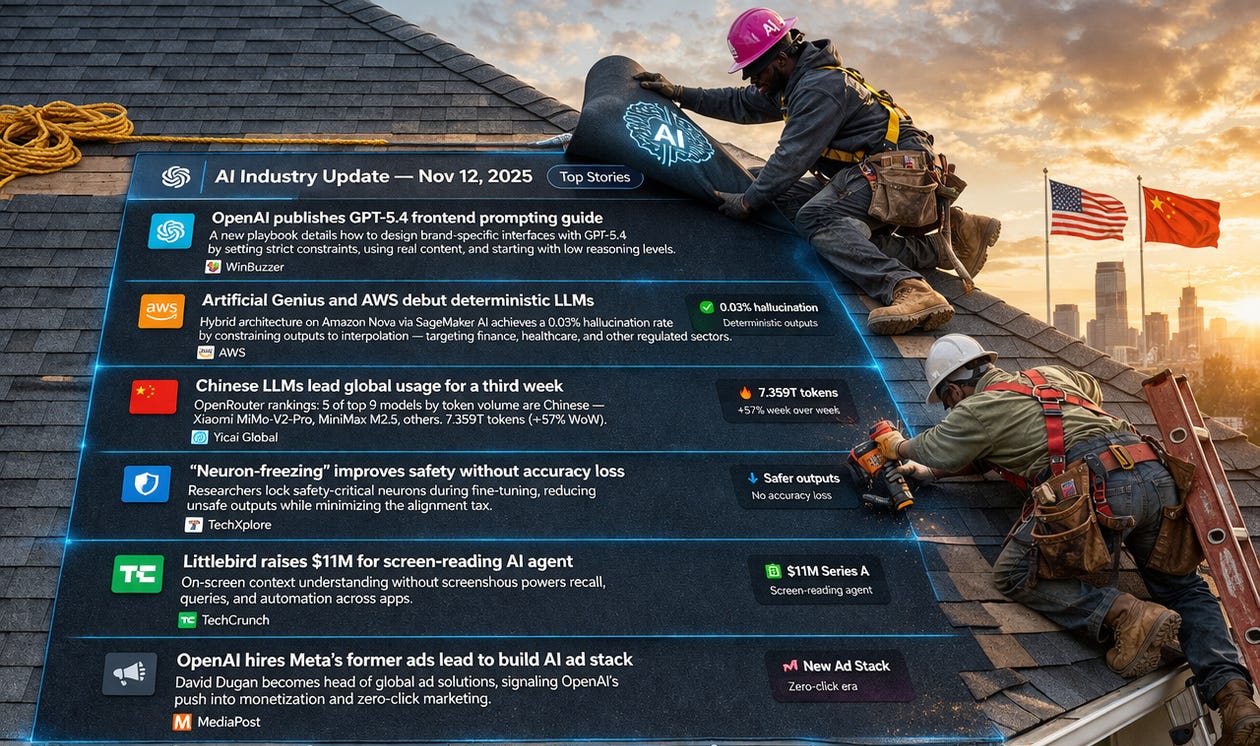
A new theme this week is that AI is becoming easier to deploy at scale, even as the rules around deployment get tighter. Bigger context windows, better interface guidance, and more efficient architectures are widening the range of practical use cases, from brand-specific frontends to deterministic systems for regulated industries. At the same time, usage data, safety research, and monetization moves point to a market that is getting both more competitive and more consequential. OpenAI’s new GPT-5.4 frontend guide is a good example of the shift from raw capability to applied craft: it explicitly advises teams to “select low reasoning level to begin with,” define hard design constraints up front, use real content, and “avoid generic, overbuilt layouts,” a sign that model quality alone is no longer enough to produce distinctive interfaces. (OpenAI Developers)
That practical turn is also visible in enterprise AI. AWS and Artificial Genius say their hybrid architecture on Amazon Nova and SageMaker is designed to be probabilistic on input but deterministic on output, specifically for regulated settings like finance and healthcare. In AWS’s description, the system aims to “intelligently constrain a model’s vast capabilities to help ensure reliability,” and a custom Nova Lite version achieved a reported hallucination rate of 0.03% on the evaluation described in the post. That is notable not because it solves hallucinations in general, but because it shows where demand is heading: toward bounded, auditable AI rather than unconstrained generation. (Amazon Web Services, Inc.)
Competition is also becoming more global and more open. Yicai, citing OpenRouter rankings, reports that Chinese models led global usage for a third straight week, with five of the top nine models by token volume coming from China and combined Chinese-model usage reaching 7.359 trillion tokens, up 57% week over week. U.S. models in the same top nine accounted for 3.536 trillion tokens. Even allowing for the limits of one platform’s leaderboard, the broader message is hard to miss: China’s open-model ecosystem is no longer a side story, and recent launches from companies like Xiaomi and MiniMax are translating into real usage. (Yicai Global)
Some of the most interesting movement is happening below the headline model layer. Researchers highlighted by Tech Xplore reported that “neuron-freezing” can improve safety by identifying and locking safety-critical neurons during fine-tuning, reducing unsafe outputs without the usual loss in accuracy. Startups are also racing to own user context: Littlebird raised $11 million for a tool that continuously understands what is on a user’s screen and turns that live context into recall, queries, and automation across apps. And Google’s Personal Intelligence rollout in the U.S. is expanding the same basic idea across Search, Gemini, and Chrome by connecting services like Gmail and Photos to generate more tailored responses, while stressing user controls over which apps are connected. (Tech Xplore)
The monetization layer is moving too. MediaPost reports that OpenAI has hired former Meta executive David Dugan as vice president and head of global ad solutions, a step that points toward a more explicit AI ad stack as conversational interfaces absorb more discovery and commerce behavior. MediaPost also says OpenAI has already begun testing advertising in ChatGPT for some lower-cost tiers, which, if sustained, would mark another step toward a zero-click environment where brands may need to optimize not just for search engines or marketplaces, but for model-mediated buying paths. (MediaPost)
The bigger takeaway is that the AI market is broadening on three fronts at once. The first is usability: better prompting guidance and more context-aware products are making models easier to shape into real interfaces. The second is deployability: deterministic methods, safety-preserving tuning, and richer context tools are making AI more viable in regulated and high-trust settings. The third is competition: Chinese open models, platform-level integrations, and ad-driven monetization are all raising the stakes. Put together, these shifts suggest that the next phase of adoption will depend less on who has the most dazzling model and more on who can make AI specific, reliable, and economically embedded in everyday systems.