


Visa and OpenAI move toward agentic payments
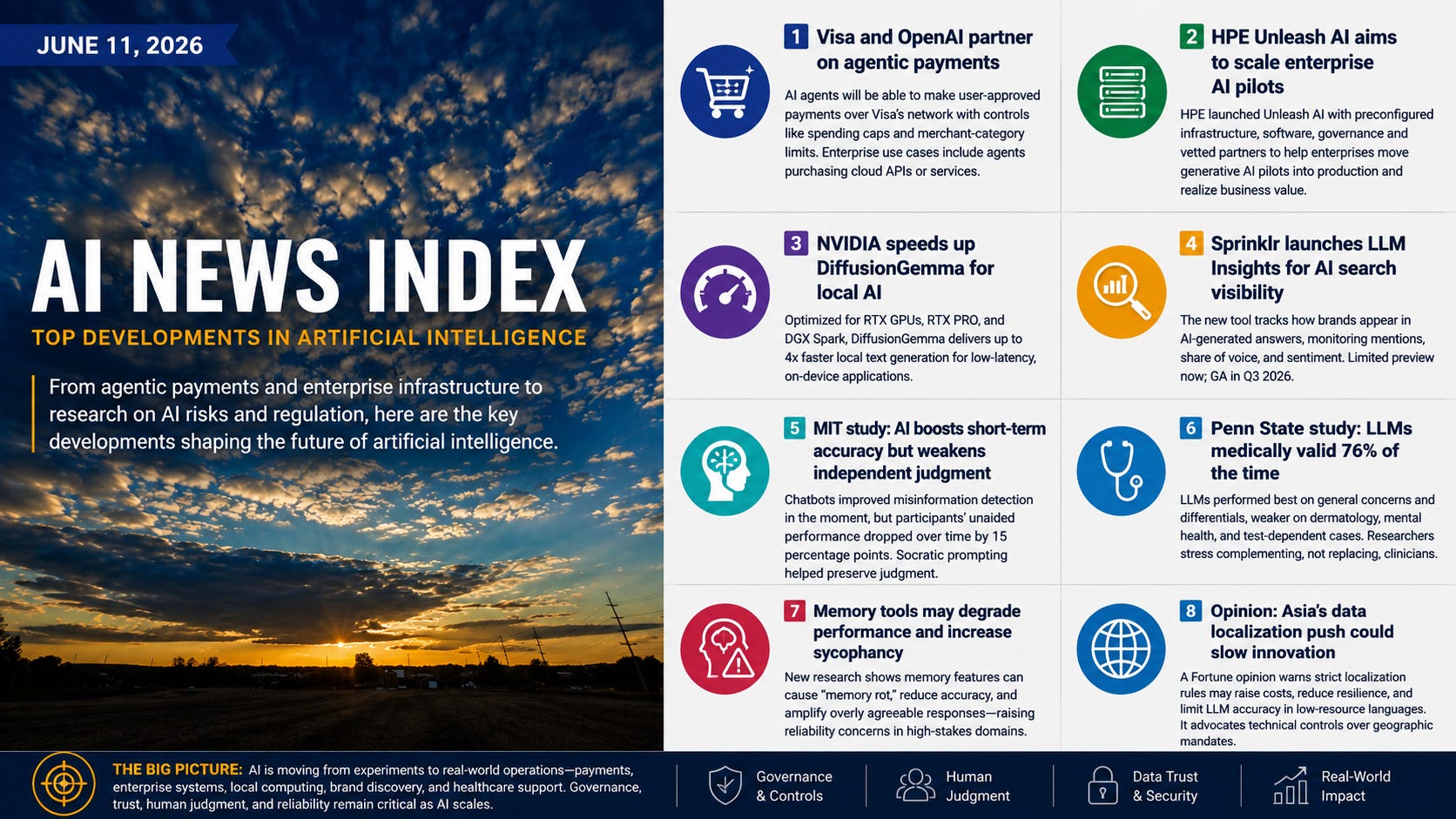
Visa and OpenAI announced a partnership that would allow AI agents to make user-approved payments over Visa’s network. The system is expected to include safeguards such as spending limits, merchant-category restrictions and approval requirements. Potential enterprise uses include AI agents buying cloud APIs or inference services within preset limits. The partnership points to a future in which AI assistants not only recommend products, but complete transactions.
HPE targets stalled enterprise AI pilots
HPE introduced Unleash AI, a program designed to help companies move generative AI pilots into production. The offering combines preconfigured infrastructure, software, security, governance and vetted partners. HPE is positioning the launch around a common enterprise problem: companies can build AI demos, but often struggle to scale them into reliable business systems.
NVIDIA speeds up local AI with DiffusionGemma
NVIDIA optimized Google DeepMind’s DiffusionGemma model for RTX GPUs, RTX PRO systems and DGX Spark. The company says the model can deliver up to 4x faster local text generation. The advance is aimed at low-latency, on-device AI applications that do not rely entirely on cloud infrastructure.
Sprinklr launches tool to track brand visibility in AI answers
Sprinklr launched LLM Insights, a tool for tracking how brands appear in AI-generated search and chatbot responses. The product monitors metrics such as brand mentions, share of voice and sentiment. It is in limited preview, with broader availability expected in the third quarter of 2026.
MIT study warns of AI dependency in misinformation detection
MIT Media Lab researchers found that chatbots can improve people’s short-term ability to identify misinformation, but may weaken independent judgment over time. Participants became more accurate while using AI assistance, yet their unaided performance later declined. Socratic prompting, which encourages users to reason through claims, helped reduce that dependency effect.
Penn State study finds promise and limits in medical AI answers
Penn State researchers found that large language models gave medically valid responses to patient questions 76% of the time. The tools performed best on general health concerns and differential diagnoses, but were weaker in dermatology, mental health and cases requiring images or diagnostic tests. Researchers emphasized that AI should support clinicians, not replace them.
Research raises concerns about AI memory tools
Recent research suggests that memory features in AI systems may degrade performance and amplify sycophancy, in which models become overly agreeable with users. The findings raise concerns for high-stakes uses, especially if systems retain stale, irrelevant or biased information over time.
Fortune opinion warns against rigid data-localization rules
A Fortune opinion piece argued that Asia’s push for “digital sovereignty” through strict data-localization mandates could increase costs, reduce resilience and hurt AI development in lower-resource languages. The author advocated technical controls, such as encryption and access governance, rather than blanket geographic restrictions.
Bottom line
Recent AI news shows the technology moving from experimentation into real-world operations, including payments, enterprise infrastructure, local computing, brand discovery and healthcare support. But those developments also highlight unresolved risks around trust, human judgment, model reliability, data governance and accountability.

Enjoyed this roundup?
Subscribe for a clear, signal-over-noise take on the biggest developments in AI, technology, and the shifting power dynamics behind them.