


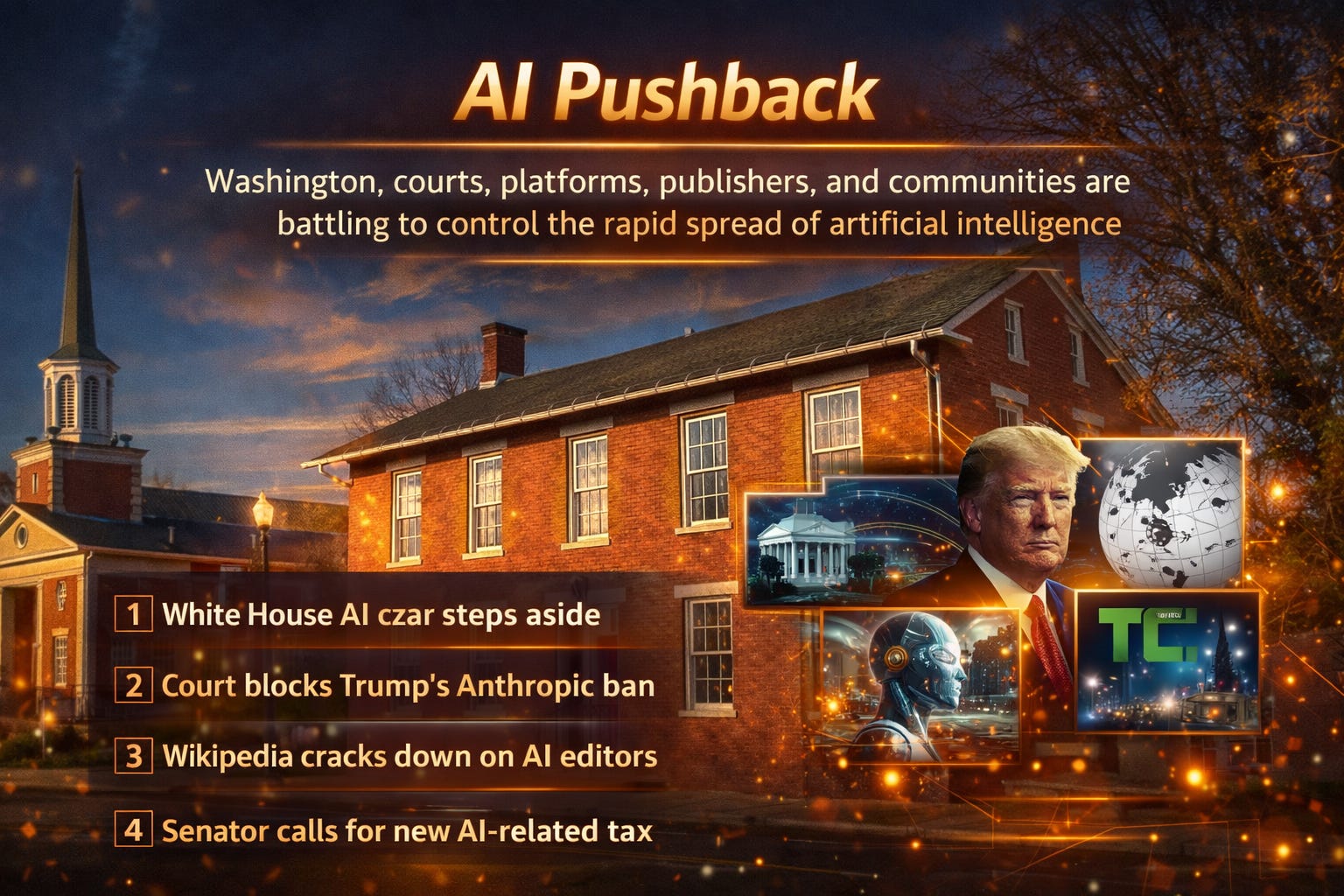
Artificial intelligence news has tilted toward power and control: who sets the rules, who gets distribution, who owns the customer relationship, and who bears the social costs when AI goes wrong. The strongest stories today span Washington, courts, platforms, publishers, and classrooms, which is why this list leans on a wider mix of outlets than usual.

White House AI czar Sacks to step down, moves to advisory role — Reuters. This is one of the day’s most consequential AI power stories because David Sacks has been central to the administration’s AI and crypto posture. Reuters reports that he is leaving the czar role and shifting to an advisory position, which matters because federal AI policy is still being actively shaped, and personnel changes at this level can alter both the pace and priorities. (Reuters)
Anthropic Wins Court Order Pausing Trump Ban on AI Tool — Bloomberg. This is a major policy-and-industry story because it keeps Anthropic in the government market for now. Bloomberg reports that a federal judge issued a preliminary injunction pausing the administration’s effort to cut off government use of Anthropic’s technology while the case plays out, underscoring how high-stakes the fight over approved AI vendors has become. (Bloomberg)
OpenAI’s US ad pilot exceeds $100 million in annualized revenue in six weeks — Reuters. OpenAI is developing a serious ad business much faster than many expected. Reuters says the pilot has already crossed the $100 million annualized revenue run rate, suggesting ads could become a meaningful second engine alongside subscriptions and enterprise sales. (Reuters)
Apple will reportedly allow other AI chatbots to plug into Siri — The Verge. This is a big platform-distribution story because it points to Siri becoming more of an AI routing layer than a closed assistant. The Verge, citing Bloomberg, reports that Apple’s next Siri architecture may let users connect third-party chatbots like Claude or Gemini, a move that could reshape how AI services compete on the iPhone. (The Verge)
Google’s ‘live’ AI search assistant can handle conversations in dozens more languages — The Verge. This is a major product-expansion story because it pushes conversational AI search into much broader global use. The Verge reports that Google is expanding Search Live to more than 200 countries and territories and to dozens of languages, powered by Gemini 3.1 Flash Live. (The Verge)
Mistral AI just released a text-to-speech model it says beats ElevenLabs — and it’s giving away the weights for free — VentureBeat. This stands out because it is both a model release and a strategic shot at closed commercial voice platforms. VentureBeat reports that Mistral launched Voxtral TTS as an open-weight enterprise-focused text-to-speech model, which is notable in a market where most leading voice systems are proprietary. (Venturebeat)
Wikipedia cracks down on AI use in article writing — TechCrunch. TechCrunch reports that Wikipedia has banned editors from using AI-generated text in articles, even while stopping short of banning AI entirely from editorial workflows. (TechCrunch)
Teens get probation after using AI to create fake nudes of classmates — AP. This remains one of the clearest real-world harm stories in the current cycle. AP reports that two boys received probation after creating about 350 fake nude images affecting at least 59 girls, a case that shows how quickly consumer AI abuse is colliding with schools, families, and courts. (AP News)
A ‘pound of flesh’ from data centers: one senator’s answer to AI job losses TechCrunch reports on a proposal to require data-center operators to contribute more, amid fears that AI may eliminate jobs faster than communities can adapt. (TechCrunch)
The debut of Gemini 3.1 Flash Live could make it harder to know if you’re talking to a robot — Ars Technica. This is one of the sharper product-analysis stories today because it highlights the social implications of more natural audio AI. Ars reports that Google’s new conversational audio model is rolling out across search, Gemini, and developer tools, raising the stakes around disclosure and human-machine ambiguity. (Ars Technica)
The three I’d read first are the Reuters report on Sacks stepping aside, the Bloomberg piece on Anthropic’s court win, and the Reuters story on OpenAI’s ad pilot, because together they capture the day’s central shift: AI is no longer just a technology race, but a contest over governance, distribution, and monetization.
Enjoyed this roundup?
Subscribe for a clear, signal-over-noise take on the biggest developments in AI, technology, and the shifting power dynamics behind them.