


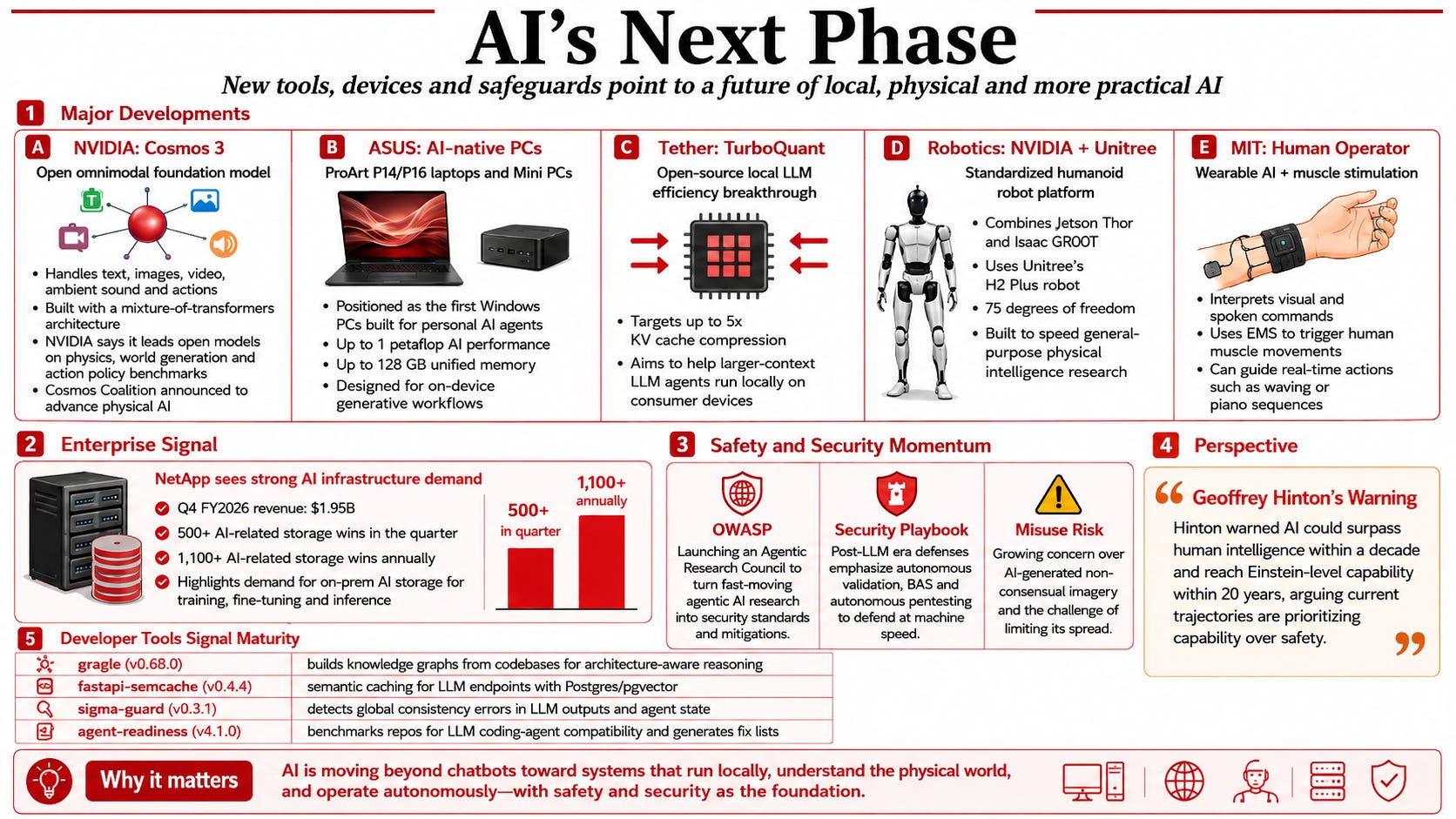
AI is no longer just something we type prompts into.
The latest announcements point to something bigger: AI that can see, hear, work locally, help developers build smarter systems, and support robots and wearables in the physical world.
In other words, AI is beginning to grow up.
Recent updates from NVIDIA, ASUS, Tether, MIT, OWASP, and others show the industry moving from cloud-only chatbots to more capable, personal, and grounded AI systems.
NVIDIA’s Cosmos 3 Pushes AI Toward Physical Understanding
NVIDIA’s launch of Cosmos 3 is one of the clearest signs of where AI is heading.
Cosmos 3 is an open omnimodal foundation model, meaning it is designed to handle multiple types of inputs together—such as text, images, video, ambient sounds, and physical actions—rather than treating each as a separate task. This helps it understand them as a whole.
That matters because the real world is not made of text alone. A robot, vehicle, factory assistant, or home AI system needs to understand motion, sound, timing, cause and effect, and physical space.
NVIDIA says Cosmos 3 performs strongly on benchmarks related to physics, world generation, and action policy. The company also announced a Cosmos Coalition to help advance physical AI applications.
The positive takeaway is simple: AI is becoming better at understanding how the world works, not just how language works.
That paves the way for smarter, safer, more capable AI tools for real-world applications.
AI-Native PCs Bring Generative AI Closer to Home
For a long time, powerful AI felt like something that lived in massive data centers. That is changing.
ASUS introduced new ProArt P14 and P16 laptops, along with Mini PCs featuring NVIDIA RTX Spark. These machines are being positioned as some of the first Windows PCs built specifically for personal AI agents.
The headline claims are impressive: up to 1 petaflop of AI performance and 128 GB of unified memory for on-device generative workflows.
In everyday terms, this means creators, developers, researchers, and small businesses may soon be able to run serious AI workloads directly on their own machines. That could include image generation, video editing, coding agents, local assistants, design tools, and private document analysis.
This is a big shift.
When AI runs locally, users can gain more speed, more control, and potentially more privacy. Instead of sending every task to the cloud, people may be able to keep sensitive files and creative work on their own devices.
The personal computer is poised to become a hub for personal AI.
Local LLMs Are Getting More Practical
Another encouraging development comes from Tether’s AI Research Group, which released TurboQuant, an open-source project aimed at making larger-context language models easier to run on consumer devices.
TurboQuant targets up to 5x KV cache compression. In simpler terms, this means it can store conversation and data history much more efficiently. Large language models (LLMs) need memory to keep track of long conversations, documents, and agent workflows. With better compression, stronger models can run on regular devices.
That means better local AI assistants, longer-context coding tools, and more capable agents that do not always need a cloud connection.
The future is a flexible blend—more local AI means greater accessibility.
Robots Are Getting Better Building Blocks
NVIDIA also partnered with Unitree on a standardized humanoid robot platform that combines Jetson Thor, Isaac GR00T, and Unitree’s H2 Plus robot, which has 75 degrees of freedom.
This partnership aims to accelerate research into general-purpose physical intelligence.
That phrase can sound futuristic, but the goal is practical: give researchers and developers a stronger shared platform for teaching robots to perceive, reason, move, and act in the real world.
A standardized platform could speed up progress. Instead of every team starting from scratch, more researchers can build on common tools, compare results, and improve real-world robot behavior.
Many possibilities are emerging, even as challenges remain.
Wearable AI Shows a New Kind of Human-Computer Interface
MIT’s Human Operator project points to another fascinating possibility: AI systems that do not just respond on a screen but interact directly with the body.
The wearable AI system interprets visual and spoken commands, then uses electrical muscle stimulation to trigger real-time human movements. Demonstrations include actions such as waving or playing piano sequences.
This kind of technology raises serious questions about safety, consent, and design. But it also shows how creative the next generation of interfaces may become.
Instead of relying solely on keyboards, phones, touchscreens, or voice assistants, future AI systems may help people learn physical skills, support rehabilitation, assist people with mobility challenges, or create new forms of human-machine collaboration.
Handled responsibly, this could become a powerful assistive technology.
Enterprises Are Investing in AI Infrastructure
The enterprise side of AI is also gaining momentum.
NetApp reported strong AI-related demand, including more than 500 AI-related storage wins in one quarter and over 1,100 annually. That points to growing interest in on-premises AI storage for training, fine-tuning, and inference.
This matters because AI is not just about flashy demos. Businesses need reliable infrastructure to manage data, protect sensitive information, and run models efficiently.
On-prem AI demand suggests that companies want more control over their AI environments. They are thinking about privacy, latency, cost, compliance, and performance.
That is a healthy sign for the industry. It means AI is becoming part of serious long-term technology planning, not just experimentation.
Safety and Security Are Moving Into the Spotlight
The progress is exciting, but it also comes with responsibility.
OWASP is launching an Agentic Research Council to help translate fast-moving agentic AI research into practical security standards and mitigations. This is important because AI agents introduce new risks. They can take actions, call tools, interact with systems, and make decisions across complex workflows.
Security teams are also preparing for what some call a “post-LLM era,” in which defenses need to move at machine speed. Ideas such as autonomous validation, breach and attack simulation, and autonomous penetration testing are becoming more important.
At the same time, concerns around AI misuse remain serious. PBS highlighted the growing crisis of AI-generated non-consensual imagery and the difficulty of stopping its spread.
These issues cannot be brushed aside. The future of AI depends not only on making systems more powerful, but on making them safer, more accountable, and more respectful of human rights.
The encouraging part is that security and safety conversations are no longer side notes. They are becoming central to how the field moves forward.
Geoffrey Hinton’s Warning Is a Reminder to Build Carefully
AI pioneer Geoffrey Hinton has warned that AI could surpass human intelligence within a decade and reach Einstein-level capabilities within 20 years. His concern is that current development may be prioritizing capability faster than safety.
Whether timelines prove accurate or not, the warning is worth taking seriously.
The best future for AI is not one where we race blindly toward power. It is one where we build thoughtfully, test carefully, and keep human benefit at the center.
Progress and caution are not opposites. In fact, they need each other.
Developer Tools Are Making Agentic AI More Reliable
Another promising sign is the growth of developer tools designed to make AI agents easier to build, test, and trust.
Several newer tools point in that direction:
graqle builds knowledge graphs from codebases, helping AI systems reason about software architecture more intelligently.
fastapi-semcache introduces semantic caching for LLM endpoints using Postgres (a type of database) and pgvector (a tool for storing data as mathematical vectors). This can help AI applications run faster and use resources more efficiently.
sigma-guard detects global consistency errors in LLM outputs and agent state, helping reduce unreliable behavior.
agent-readiness checks if software repositories will work smoothly with coding AI agents. It also creates lists of what needs to be fixed to make them compatible.
These tools may not get the same attention as major model launches, but they are important. They show that agentic AI is maturing from impressive demos into a real engineering discipline.
The next phase of AI will depend on reliability. Developers need tools that make agents easier to inspect, debug, benchmark, and improve. That is exactly the kind of foundation this ecosystem is beginning to build.
The Bigger Picture: AI Is Becoming More Capable, Personal, and Practical
Taken together, these developments tell a clear story.
AI is moving beyond chat windows, becoming multimodal, local, physical, agentic, and more integrated into people’s existing tools.
We are seeing AI that understands video and sound, runs on personal computers, supports robotics research, helps developers with software architecture, improves enterprise workflows, and creates new human-machine interfaces.
There are real risks, and they deserve serious attention. But there is also enormous promise.
The most hopeful version of the AI future is not about replacing people. It is about expanding what people can do.
Creators could work faster. Researchers could test ideas sooner. Developers could build more reliable software. Doctors and therapists could gain better assistive tools. Businesses could make smarter use of their data. Robots could take on dangerous or repetitive tasks. Individuals could have private, local AI systems that help them learn, organize, design, and create.
That future is not guaranteed. It has to be built with care.
But the direction is becoming clearer: AI is turning into a new layer of capability across personal computing, robotics, enterprise infrastructure, and software development.
And if we get the balance right, this next wave of AI could become one of the most useful technologies people have ever had at their fingertips.

Enjoyed this roundup?
Subscribe for a clear, signal-over-noise take on the biggest developments in AI, technology, and the shifting power dynamics behind them.